

From a chance encounter with good coffee in Covent Garden to roasting beans in an old farm building in the Kent countryside, Grant’s journey into coffee has been anything but planned. We spend an afternoon at Coldblow Coffee to discover how curiosity, practical thinking and relationships have quietly shaped the business – and opened a window onto a much bigger world.
The fan hums steadily in the corner of the room, angled towards the tasting bench in a determined attempt to move the warm air gathering beneath the roof of the old farm building. It isn’t having much success.
Grant smiles when I suggest the heat must at least be welcome during the winter months.
“It just disappears,” he says, glancing towards the roof. “It all rises.”
The large doorway remains open, screened by a simple mesh net that allows the breeze inside while keeping Forest, the resident dog, from wandering off. Outside, chickens roam freely around the yard, occasionally venturing a little too close before thinking better of it. Nothing about the arrangement feels designed for visitors.
It is simply another working day.
Grant doesn’t launch into a carefully rehearsed explanation of coffee.
Instead, he answers thoughtfully, pausing between questions before occasionally getting to his feet when something is easier to show than describe.
Halfway through our conversation, a delivery van pulls into the yard.
This is Forest’s moment.
The quiet of the afternoon briefly gives way to enthusiastic barking as he races towards the doorway. Across the table, Jemma looks up from the paperwork she’s been working through over a hastily interrupted lunch, quietly adding a detail to one of Grant’s answers before returning to the task in front of her.
The interruption doesn’t feel like an interruption at all. Nobody apologises. Nobody waits for silence before carrying on. The working day simply bends around whatever happens next.
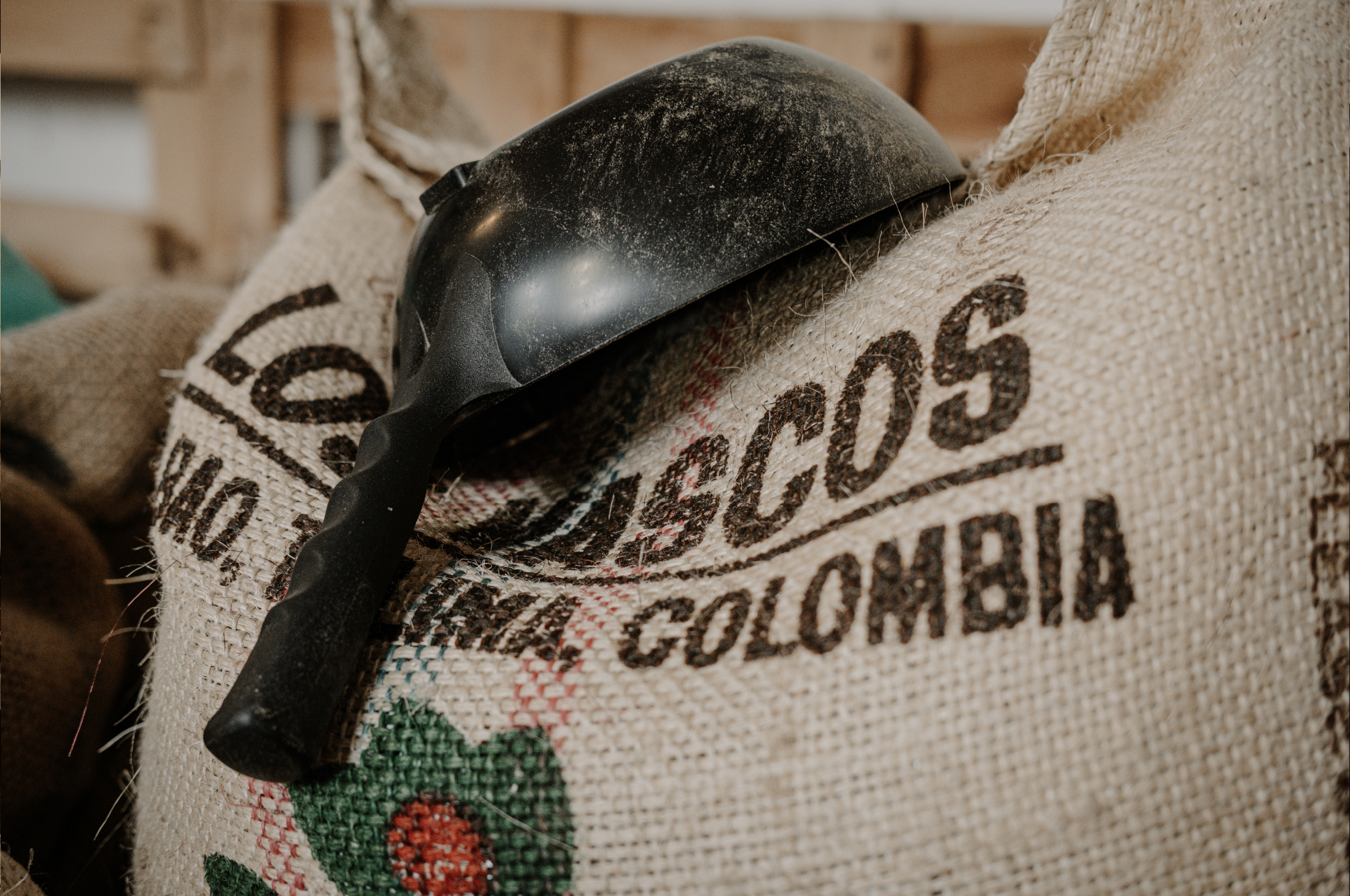
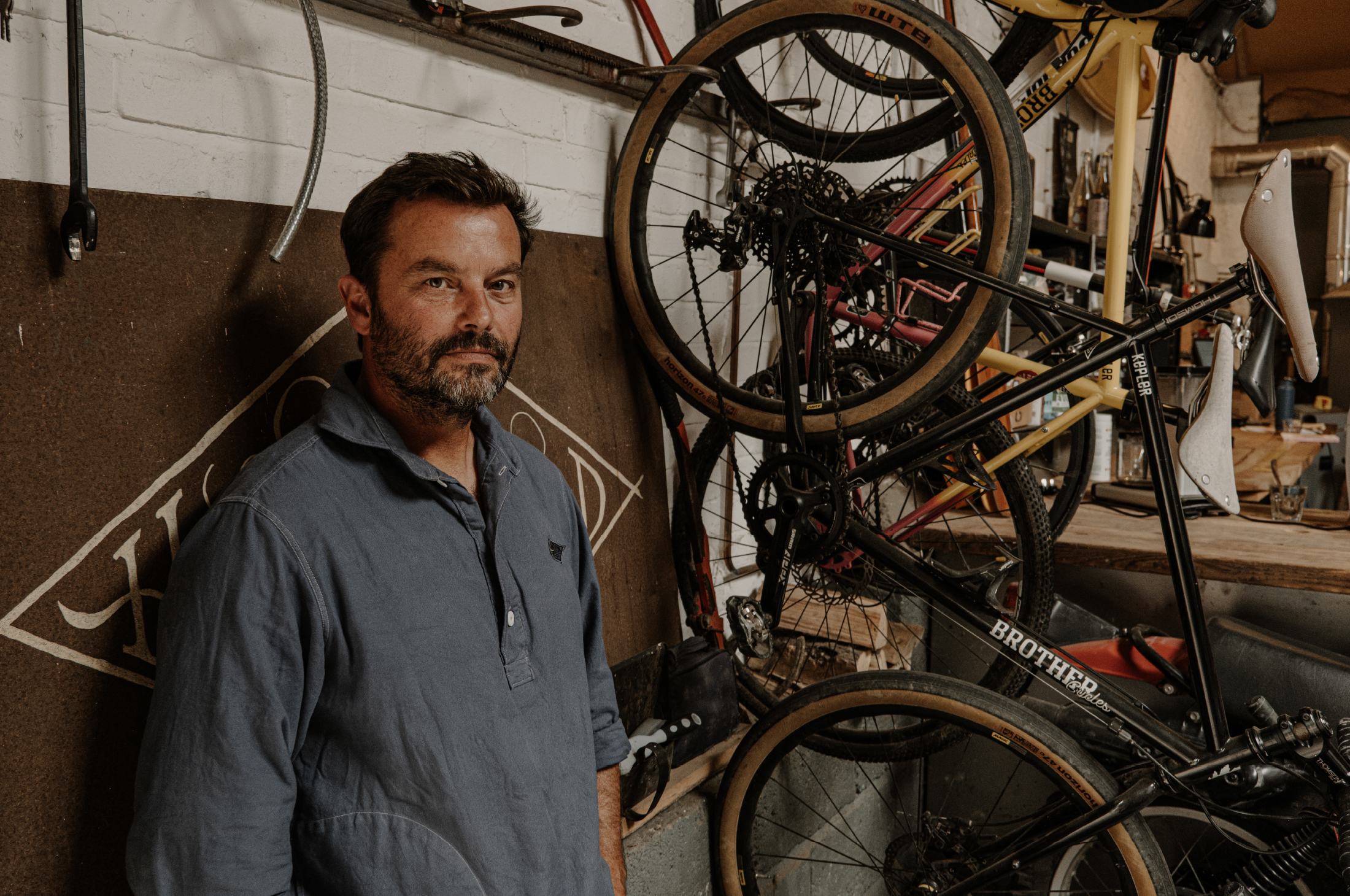
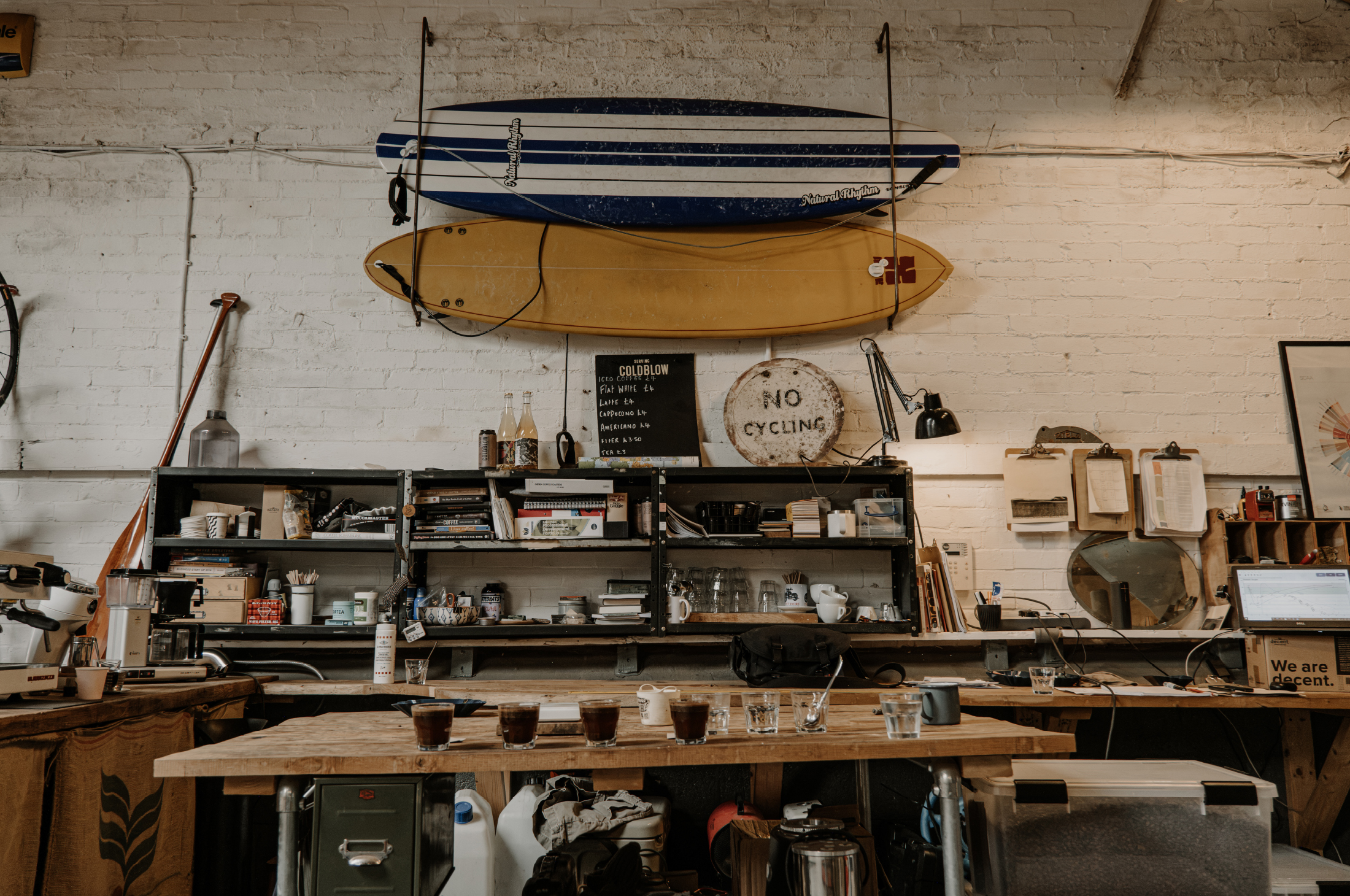
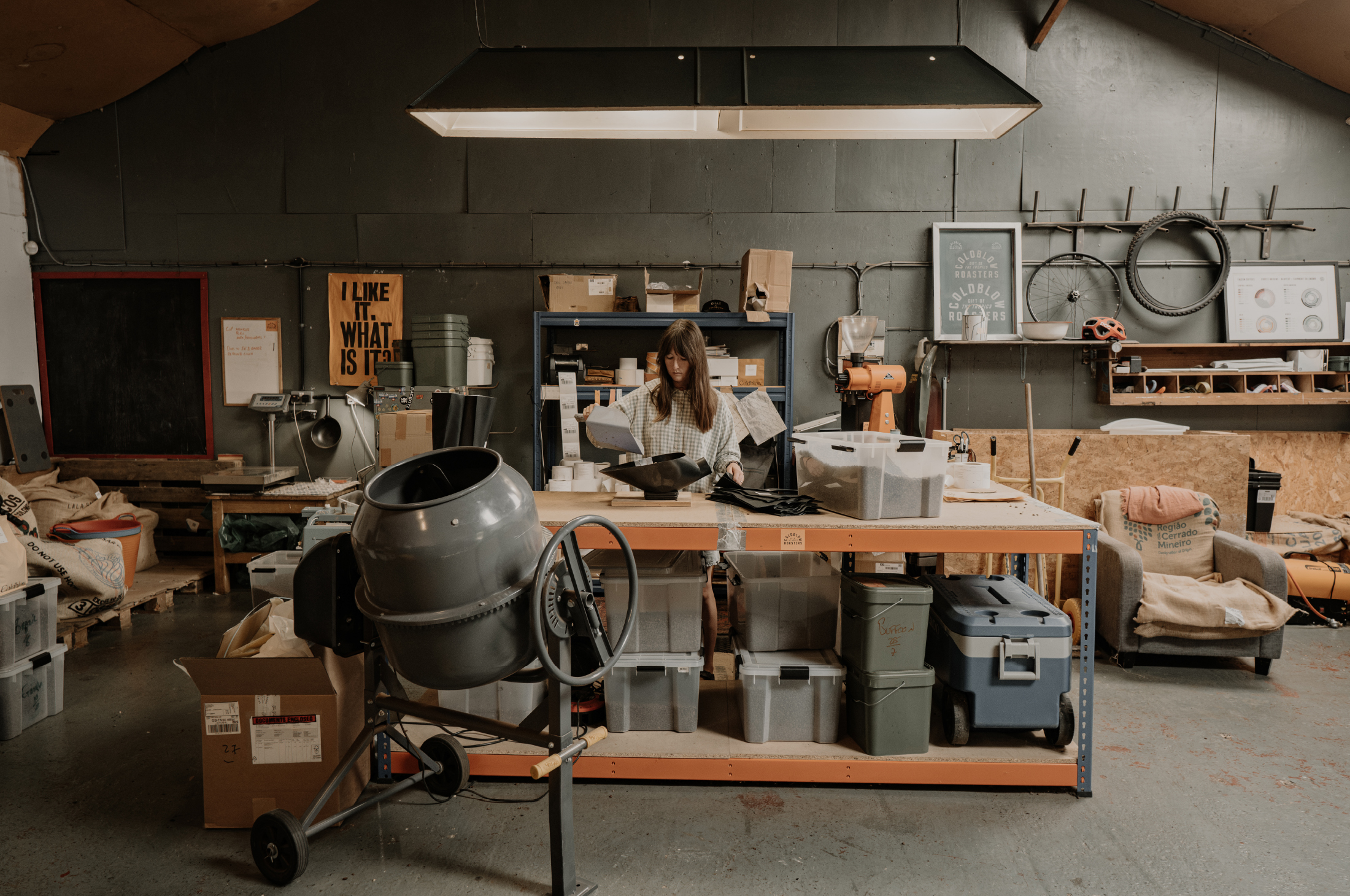
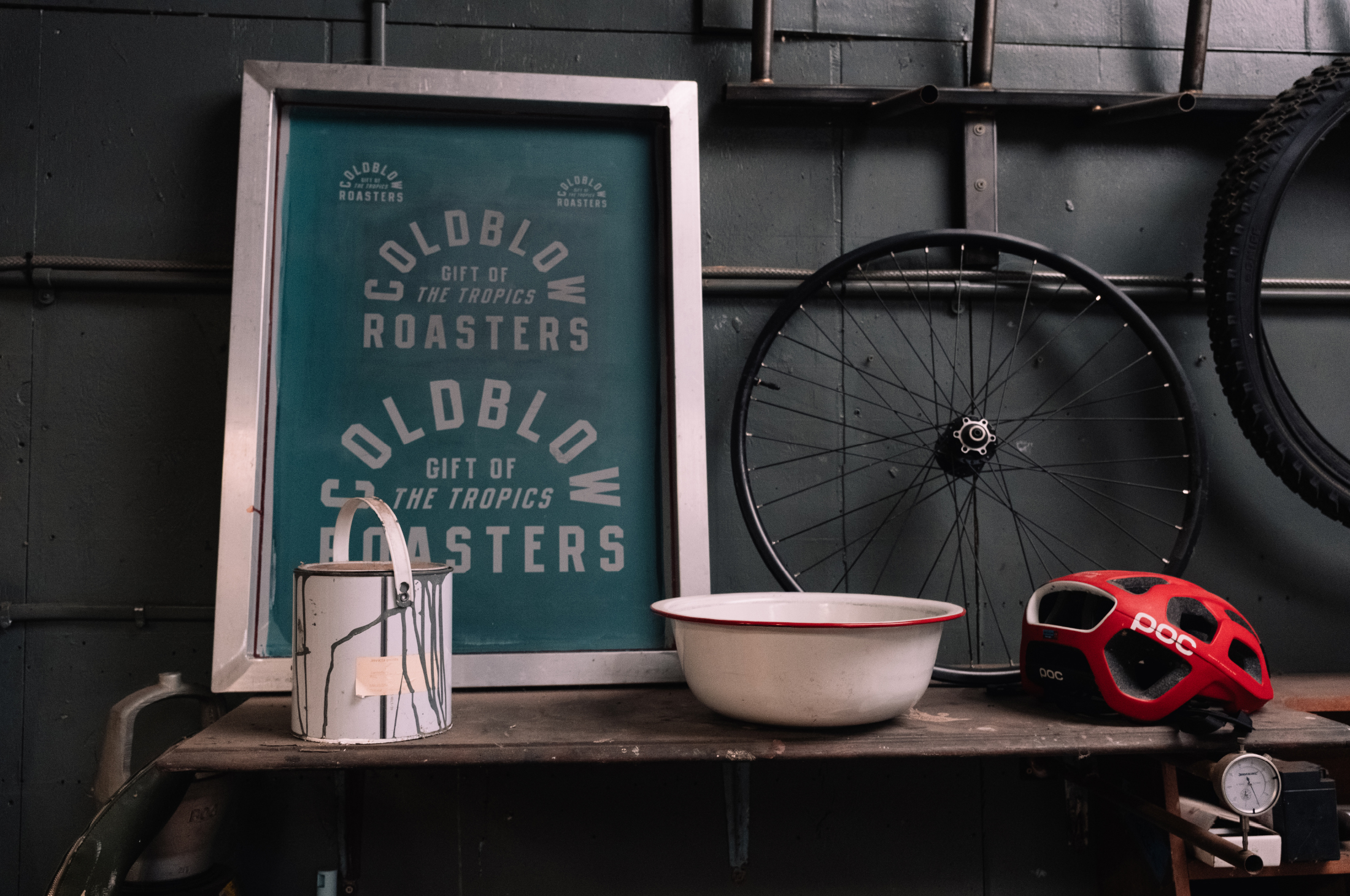
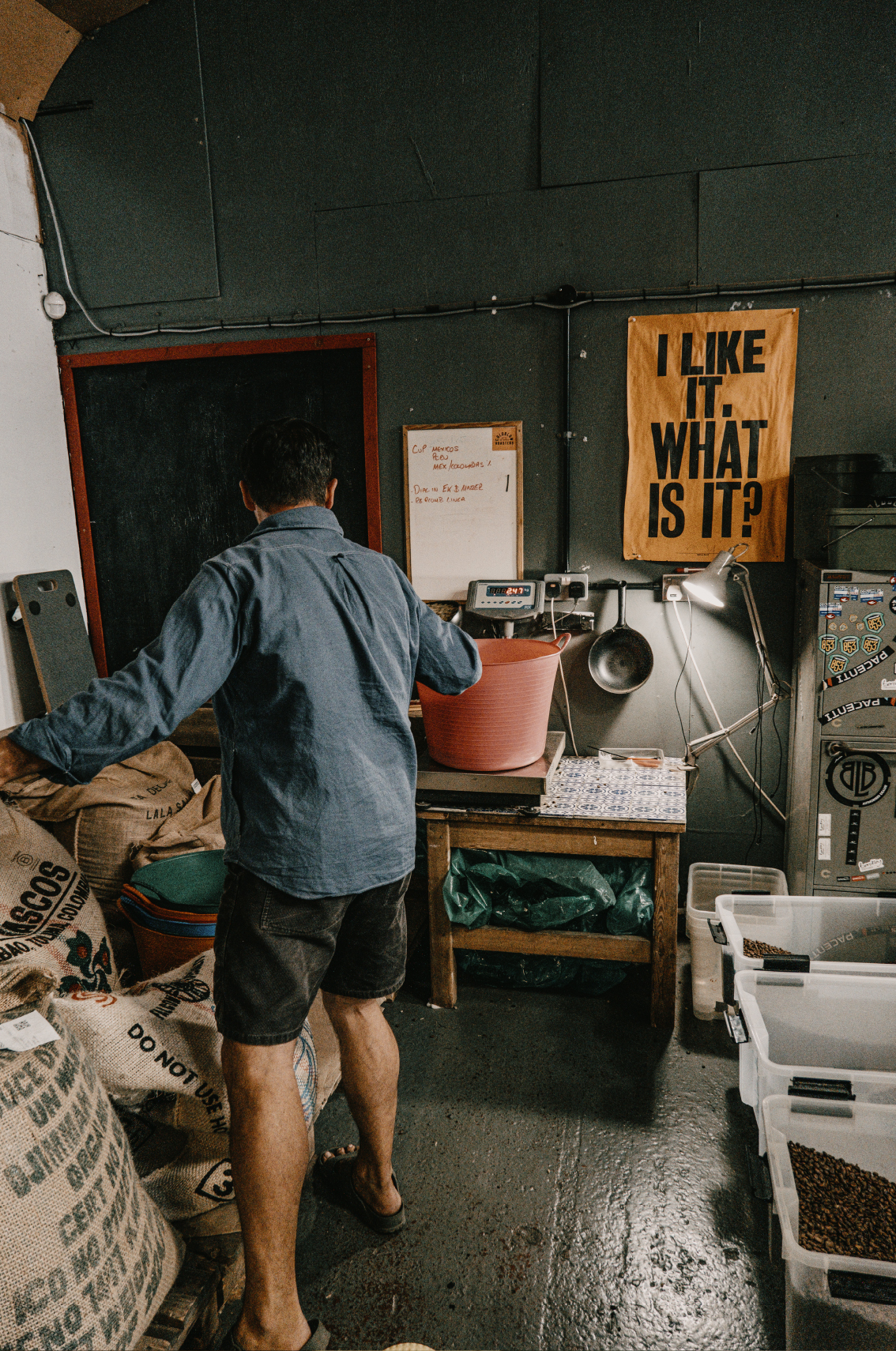
Around us, the building gradually gives itself away. Hessian sacks of green coffee rest quietly in one corner. Off-road bikes hang from the rafters, waiting for cooler weather before they’re brought back into service. Sitting amongst the roasting equipment is an immaculate grey cement mixer that seems strangely out of place, although nobody appears inclined to explain why.
The room doesn’t feel curated.
It feels lived in.
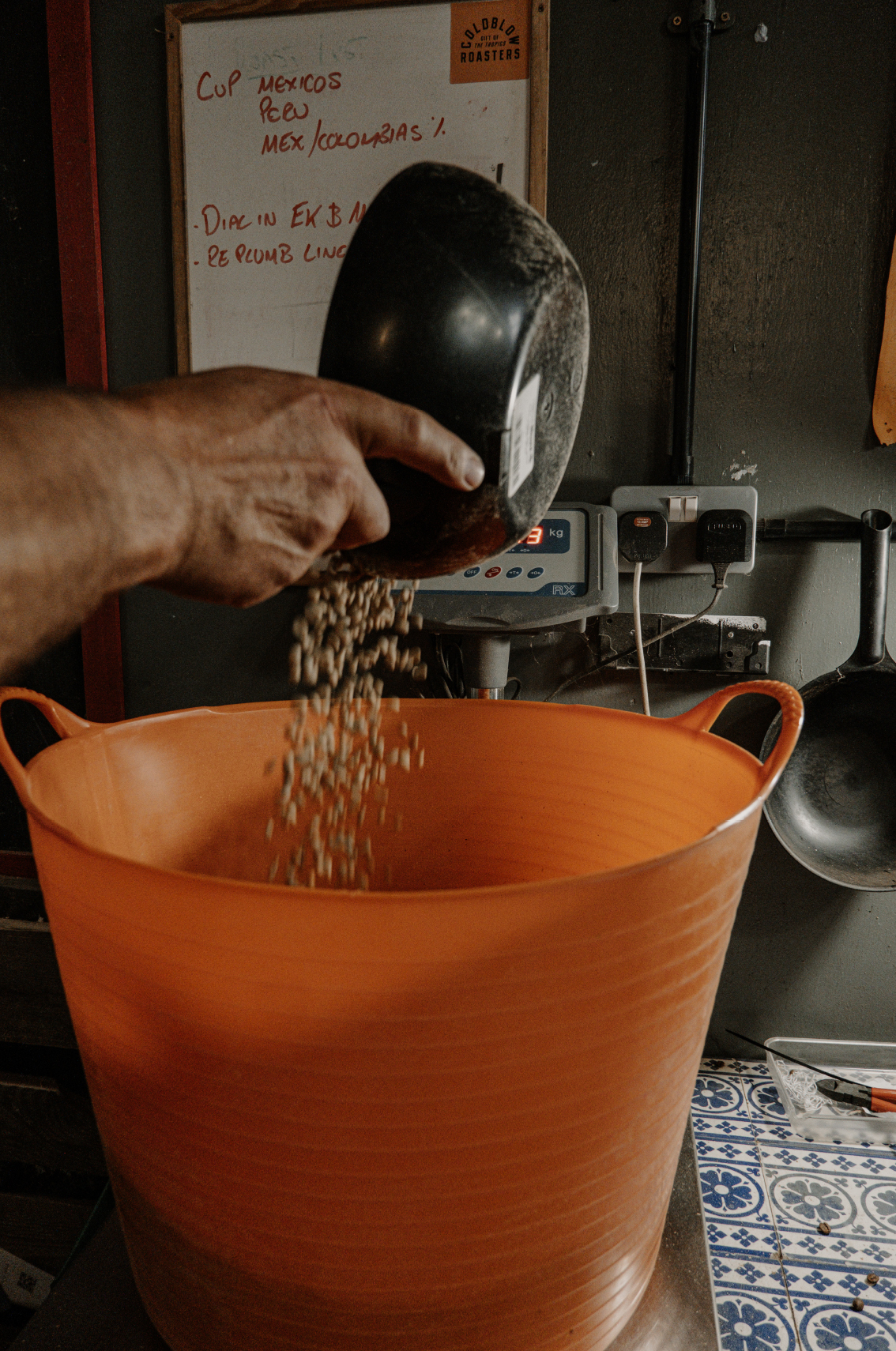
A question about green coffee prompts Grant to walk over to the stack of hessian sacks. Reaching inside one with a well-used metal scoop, he gathers a handful of pale green beans and holds them out.
“Have a smell.”
The aroma is unexpectedly delicate.
Fresh.
Almost grassy.
Certainly nothing like coffee.
Before a single word has been spoken about roasting, the assumptions I arrived with have already begun to shift.
The first thing Grant tells me about coffee is that he can’t remember his first cup.
He remembers the first one that mattered, though.
At the time, he was working as a runner on the trading floor of the London Stock Exchange. Arriving early to meet his girlfriend in Covent Garden one afternoon, he wandered into Monmouth Coffee with time to spare. Sitting alone with a coffee, he watched the quiet rhythm of the place unfold around him.
Looking back now, he recognises it as an important moment.
At the time, it simply felt like an interesting place to spend half an hour.
“I’d never really experienced anything like it before,” he says.
Coffee resurfaced unexpectedly a few years later.
Having left the City behind, Grant travelled through New Zealand in a campervan. Pulling into a roadside service station one day, he ordered a coffee expecting little more than something to keep him awake for the next stretch of road.
Instead, it stayed with him.
Excellent coffee simply seemed normal.
People ordered it without ceremony. Nobody spoke about tasting notes or brewing methods. It was just good coffee, served without fuss in the sort of place where, back home, expectations would have been considerably lower.
Back in Kent, coffee once again slipped quietly into the background.
Grant retrained as a tree surgeon, spending more than a decade working outdoors while helping out in the café his then wife ran in Tenterden whenever time allowed. Later came another venture altogether: a bright orange three-wheeled Piaggio Ape van, which he fitted out with an espresso machine to serve fresh coffee to the kiteboarding community gathering along Hythe seafront.There was no elaborate business plan behind it.
Just another observation.
Plenty of people.
Nowhere serving the sort of coffee they deserved after spending the morning on the
water.
Coffee kept reappearing, not because he was searching for it, but because curiosity kept quietly leading him back.
The turning point came when years of tree surgery began demanding more of his body than it once had.
Rather than choosing another career, Grant decided to test an idea.
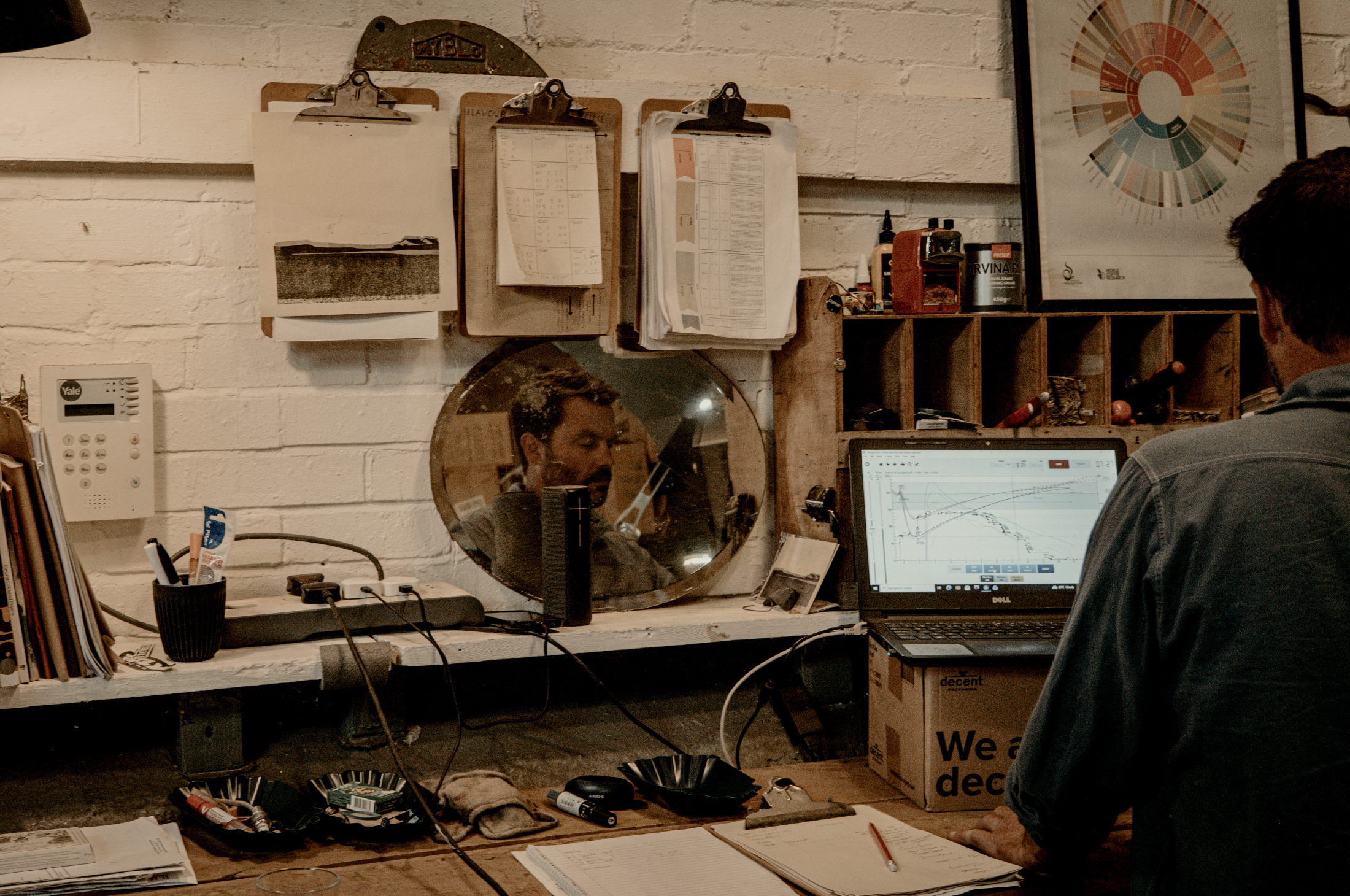
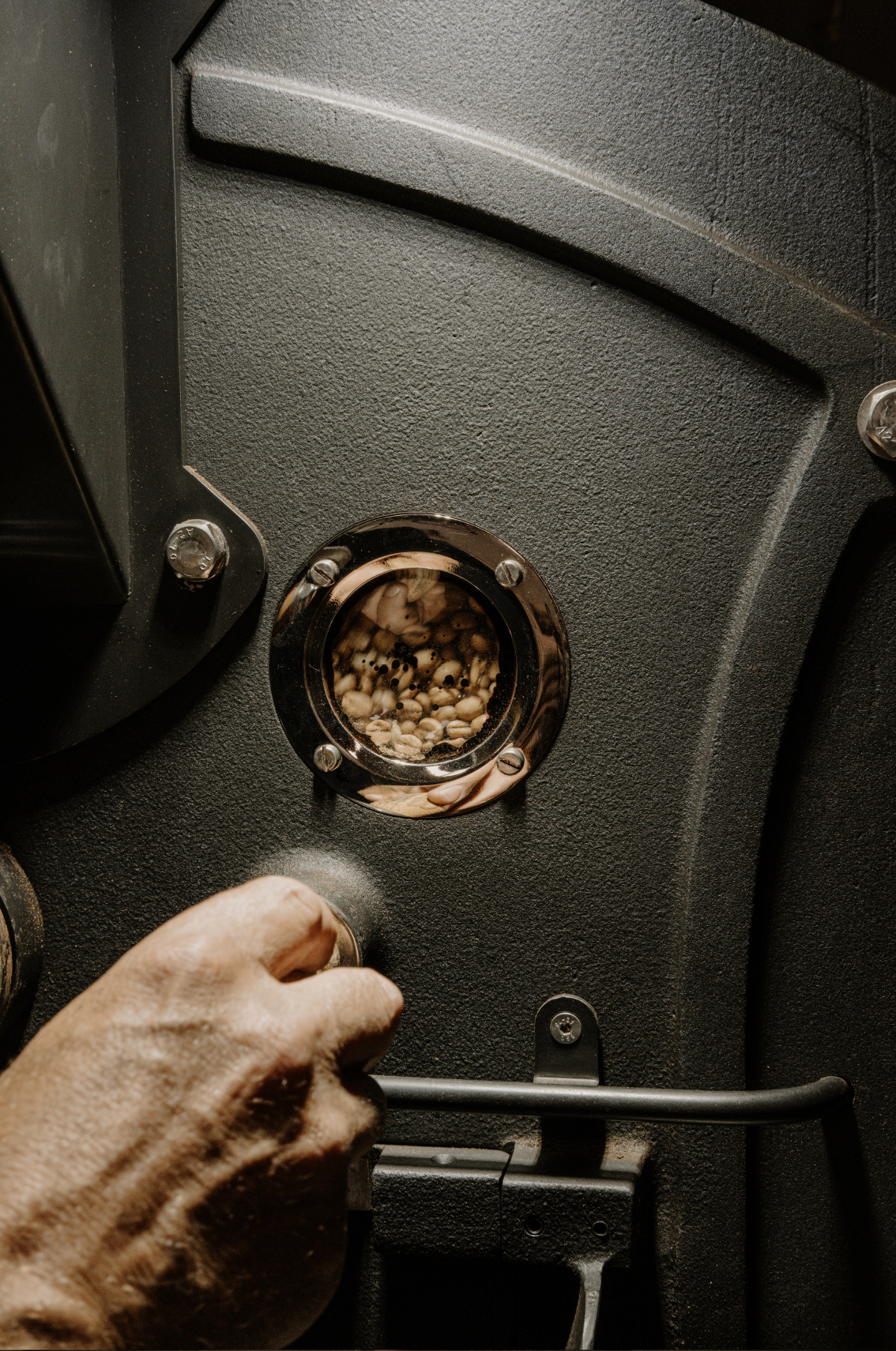
He bought a tiny American-made sample roaster capable of roasting little more than a couple of hundred grams of coffee at a time.
The question was simple.
Would he enjoy doing this every day?
“I wanted to make sure I enjoyed roasting before going any further,” he says.
The answer arrived one small batch at a time.
Roasting time.
Temperature.
Taste.
Adjust.
Repeat.
Each batch answered one question while quietly asking another.
The more Grant learnt, the more coffee seemed to expand in front of him.
“There are benchmarks,” he says. “You look at the altitude, the density, whether it’s washed or naturally processed…”
As he talks, he wanders back towards the sacks of green coffee.
It becomes increasingly obvious that understanding, for Grant, has always begun with experience.
Not theory.
He rarely explains something if he can demonstrate it instead.
The scoop of green coffee.
The sacks.
The roaster.
Each answer begins with something tangible.
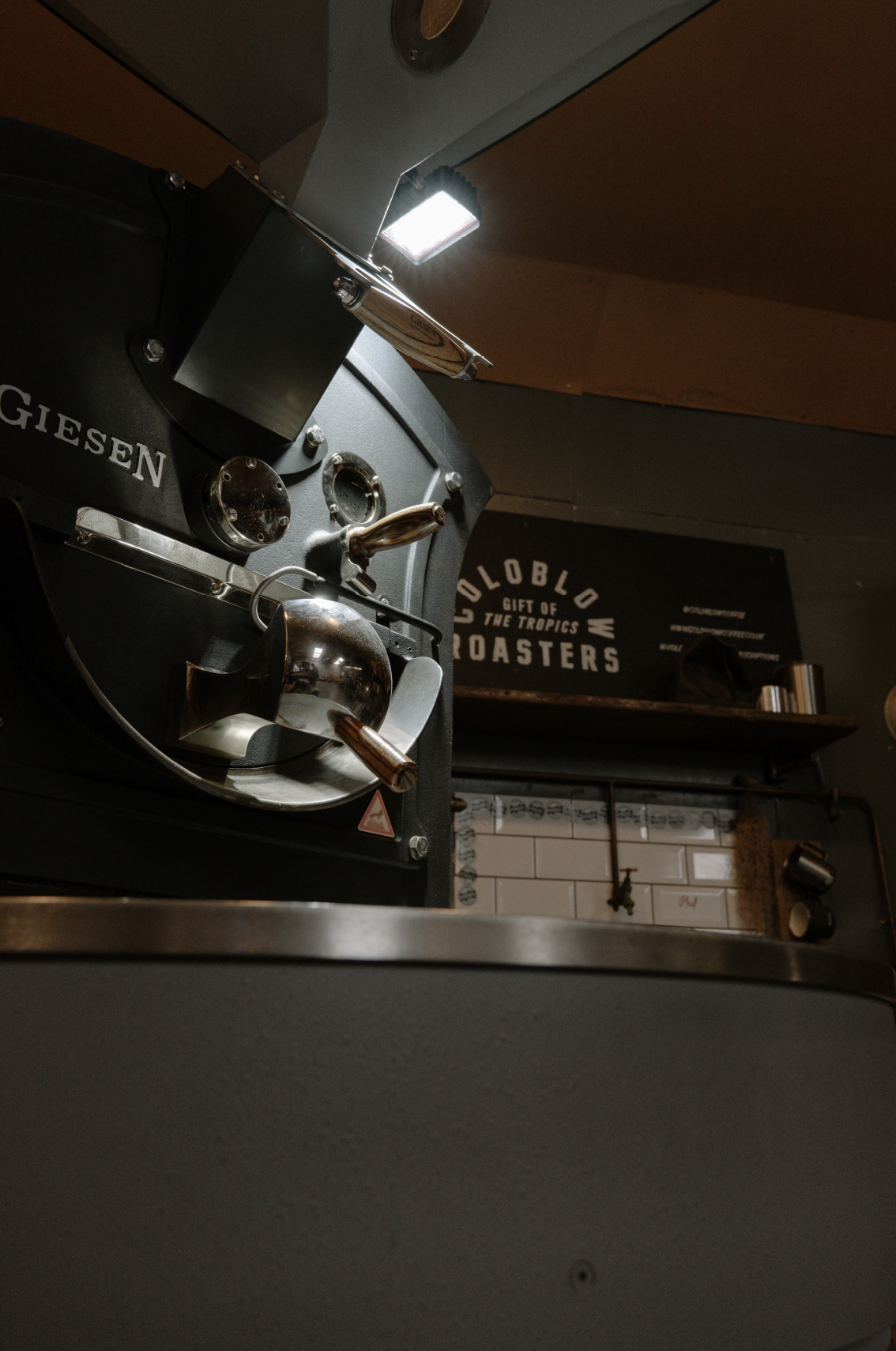
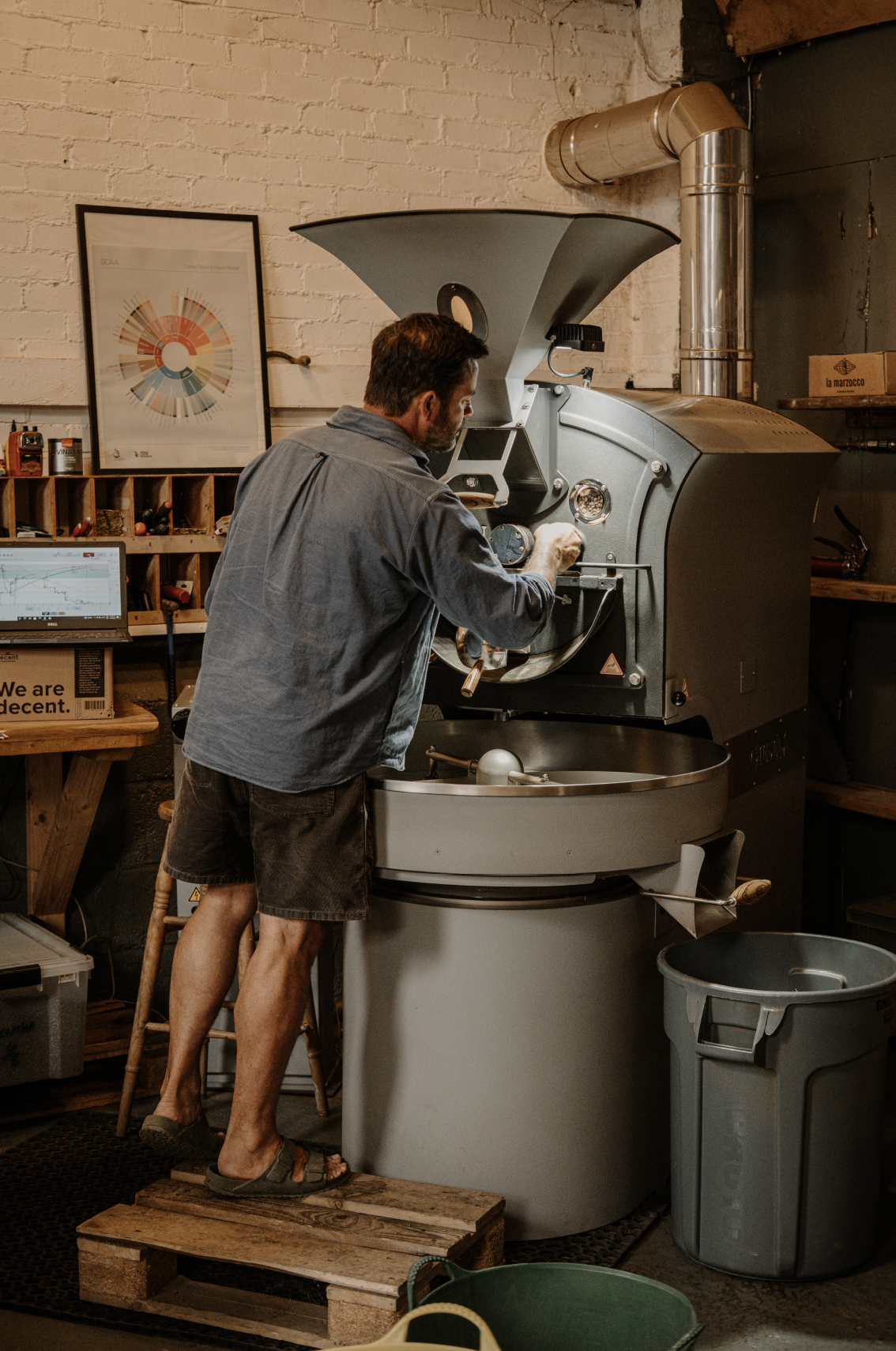
Roasting, Grant explains, is less about creating flavour than revealing it.
Every coffee arrives carrying decisions that have already been made. The variety planted, the altitude at which it was grown, the weather throughout the season, the way it was processed after harvest and dried before export; each leaves its mark long before a roaster has any influence at all.
His job isn’t to overpower those decisions.
It’s to understand them.
A dense bean grown at altitude behaves differently to one grown lower down. A naturally processed coffee asks different questions of the roaster than a washed one. The aim is always the same: to allow the character already within the bean to emerge rather than disappearing beneath a roast that makes everything taste the same.
There is undoubtedly science involved.
Yet sitting across the tasting bench from Grant, it doesn’t feel like a scientific pursuit.
It feels more like listening.
Coffee offers a response.
The roaster adjusts.
Then listens again.
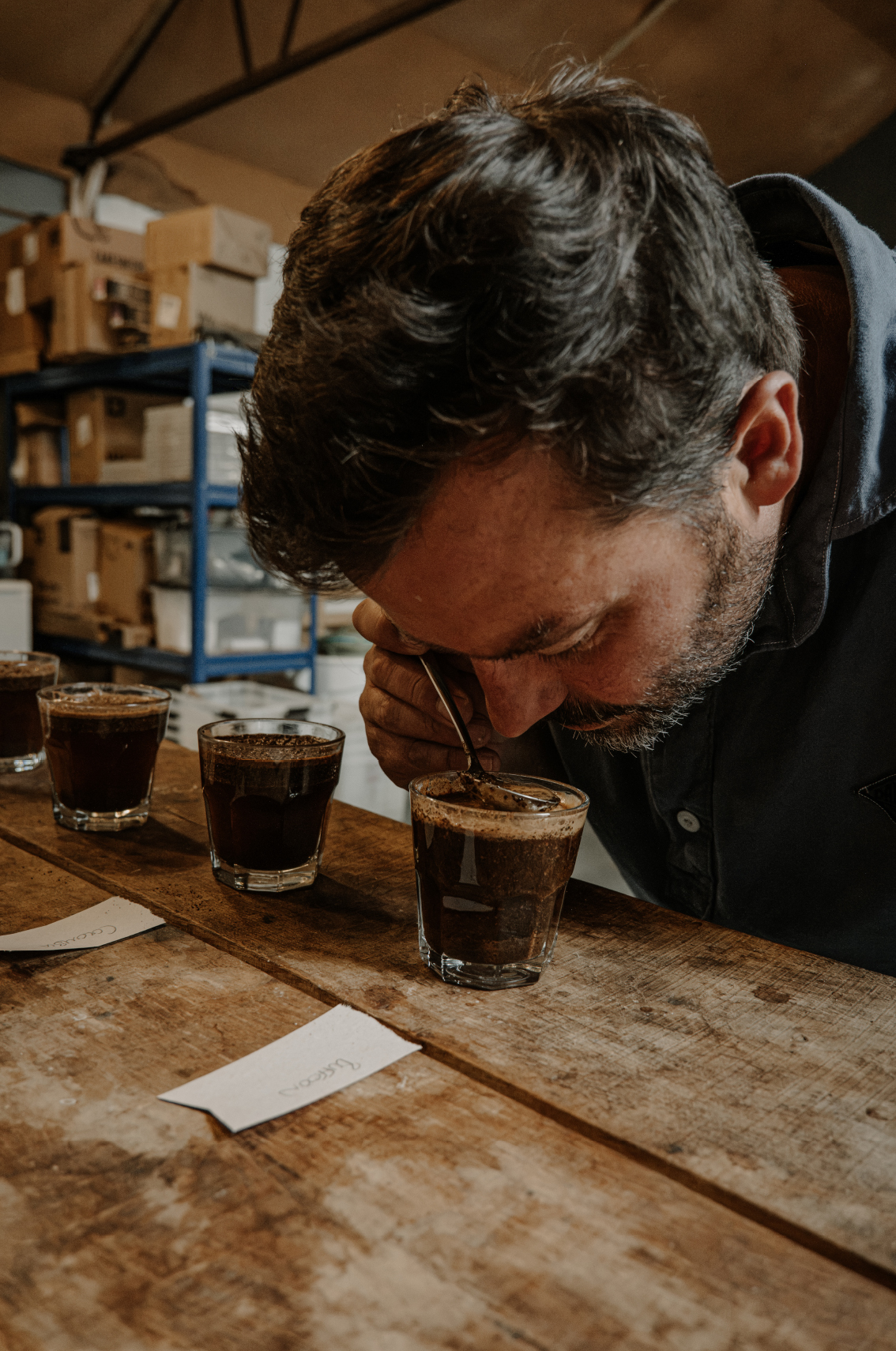
Professional coffee graders can distinguish astonishingly precise flavour characteristics, identifying not simply citrus or apple, but the subtle differences within them. Years spent roasting and tasting coffee have given Grant a finely developed palate of his own, but he is equally aware of another level of expertise beyond it.
“My palate isn’t there,” he says, smiling.
It doesn’t sound like false modesty. More an acknowledgement of just how far the world of coffee can take you. The more Grant has learnt, the more comfortable he seems with the idea that there is always something left to learn.
Looking around the room, nothing prepares you for how international this little business really is.
From the outside, Coldblow appears reassuringly local. An old farm building tucked away in the Kent countryside.
Yet every sack stacked quietly against the wall has already travelled thousands of miles before arriving here.
By the time a coffee reaches Grant, the story has already been unfolding for well over a year.
Coffee, unlike almost any other product we consume, is built on an extraordinary chain of relationships.
Growers.
Exporters.
Importers.
Roasters.
Cafés.
Each relies entirely on the work of everyone who came before them.
For a business of Coldblow’s size, those relationships begin with specialist importers. Grant speaks warmly about Falcon Coffee in nearby Lewes, whose buyers spend much of the year travelling through producing countries, building long-term relationships with growers, identifying exceptional coffees and returning season after season. Their knowledge becomes Coldblow’s knowledge, allowing a relatively small independent roastery in Kent to work with coffees whose stories begin on hillsides in Brazil, Colombia, Ethiopia and beyond.
Listening to him describe that network, it becomes difficult to think of Coldblow as an isolated business at all.
Instead, it feels like one carefully connected point within something much larger.
That understanding became considerably more tangible when Grant travelled to Brazil.
Walking through coffee farms during harvest, he watched workers moving methodically between the trees before following the coffee through each stage of processing. Conversations that had previously taken place over samples and emails were suddenly happening face to face with the people responsible for growing them.
“You see the fruit on the trees. You see the harvest happening. You see the processing. You meet the farmers.”
There is no dramatic revelation in the way Grant tells the story.
If anything, it sounds like quiet confirmation.
The names written on coffee bags became real people.
The places became landscapes.
The harvest became physical.
It also became impossible to ignore the challenges those growers increasingly face.
Harvests shift.
Weather becomes less predictable.
A frost in Brazil can influence coffee prices across the world. New varieties are constantly being trialled in the hope of producing plants capable of withstanding an uncertain future, while growers continue searching for ways to improve quality without compromising sustainability.
Back in the roastery, those conversations don’t stay in Brazil.
They quietly shape what happens here.
Which coffees are bought.
How they are roasted.
The conversations Grant has with cafés.
The advice he offers customers.
The sacks sitting patiently in the corner no longer seem like simple ingredients waiting to be transformed.
They feel more like the latest chapter in a story that began months earlier, on another continent, with people whose names most of us will never know.
Grant readily admits that speciality coffee can sometimes make life unnecessarily difficult for itself.
Customers are presented with strength scales that tell them very little. Bags are covered in tasting notes that can feel more like an examination than an invitation. Somewhere along the way, coffee has acquired a language that risks excluding the very people it hopes to encourage.
Grant seems quietly determined to move in the opposite direction.
He talks instead about sweetness.
Balance.
Enjoyment.
Darker isn’t stronger, he explains. Often, it’s simply darker. Roast too heavily and the subtle characteristics that travelled all the way from the farm disappear beneath the flavour of the roast itself.
The same thinking carries into Coldblow’s relationships with the cafés it supplies.
Coffee isn’t delivered and forgotten.
The conversation continues.
If a café wants help improving consistency, Grant is happy to spend time adjusting grinders, refining recipes or talking through extraction until everything begins working as it should.
“It’s really quite satisfying,” he says, describing those moments when everything suddenly falls into place.
He rarely talks about selling coffee.
Instead, he talks about helping people make better coffee.
By now, Forest has abandoned any responsibility for deliveries and is stretched comfortably across the floor. The fan continues its patient struggle against the warmth while Grant gets to his feet once again.
My eyes return to the immaculate grey cement mixer I’d noticed earlier.
“What about the cement mixer?”
Grant laughs.
“We use it to blend coffee.”
The explanation is wonderfully matter-of-fact.
Purpose-built coffee mixers exist, but they cost many thousands of pounds. Grant had seen another roaster using a cement mixer instead and immediately recognised the simplicity of the idea. There was no reason it couldn’t do exactly the same job.
It is one of those moments that explains far more than the object itself.
The cement mixer isn’t there to be quirky.
It isn’t there to make a statement.
It’s there because it works.
Spend enough time with Grant and a pattern gradually emerges.
He doesn’t chase complicated solutions.
He looks for good ones.
If someone has already found a better way of doing something, he’s happy to learn from it. If a practical solution outperforms a more expensive one, appearances simply don’t matter.
It is exactly the same mindset that led him to experiment with a sample roaster before committing to a new career. The same mindset that values long-term relationships over short-term trends. The same mindset that has quietly shaped Coldblow from the beginning.
Across the tasting bench, Jemma joins the conversation once more, adding the occasional detail before returning to the work spread across the table in front of her. Throughout the afternoon she has balanced paperwork, lunch, deliveries and the hundred small jobs that seem to accompany every independent business.
It quickly becomes obvious that Coldblow has become their business rather than simply Grant’s.
After years in teaching, Jemma now works alongside him full-time, helping shape the next chapter while Grant concentrates on roasting, sourcing and the relationships that have become central to the business.
That next chapter is already taking shape.
A new identity.
New packaging.
A Coffee Club that will introduce subscribers to different coffees throughout the year.
Guest-roaster collaborations that will allow Coldblow to appear in cafés beyond its existing wholesale network.
None of it feels like reinvention.
Instead, it feels like a business becoming more recognisable as itself.
The fan is still humming.
Forest barely acknowledges another vehicle pulling into the car park.
Outside, the chickens continue their slow patrol across the yard.
Nothing here has really changed since I arrived.
The building still feels lived in.
The working day simply carries on.
My eyes return to the hessian sacks stacked quietly against the wall.
Earlier that afternoon, Grant had reached inside one with a well-used metal scoop and held out a handful of pale green beans.
At the time, there had seemed very little remarkable about them.
Now, it is harder to look at those sacks without thinking about everything that brought them here. The farms and harvests. The growers. The importers returning season after season. And, finally, this small team in an old farm building in rural Kent, working out how best to continue what all of those people started.
Soon enough, those unremarkable-looking beans will leave here again.
Perhaps they’ll find their way to an independent café, into a grinder and, eventually, into a cup placed in front of someone who knows nothing about the farm where they were grown, the distance they have travelled or the number of hands involved along the way.
Perhaps they don’t need to.
Perhaps they’ll simply take a sip and think it is a very good cup of coffee.
Around them, the working day will carry on.
The small team inside an old farm building in rural Kent attempting, in their own thoughtful way, to honour all of those efforts.
Earlier that afternoon, Grant had handed me a scoop of green coffee beans and asked me to smell them.
At the time, they had seemed almost disappointingly ordinary.
Fresh.
Almost grassy.
Certainly nothing like coffee.
By the time I left, they had become something else entirely.
Not simply the beginning of a cup of coffee.
But the latest chapter in a story that had travelled thousands of miles before quietly arriving in the palm of my hand.